Former President Thomas Jefferson, who drafted the Declaration of Independence, hoped that Americans would commemorate the day they broke from British rule. Writing to a friend in the last few weeks of his life, Jefferson observed that the declaration was “pregnant with our own, and the fate of the world.”
That might sound like hubris, something America’s third president was known for. But in its day, America’s revolutionary stance was a global event. Its Declaration of Independence from the British Crown, approved on July 4, 1776, reverberated around the world and gave rise to a global war that redrew boundaries and balances of power.
Richard Bell, a Revolutionary War scholar at the University of Maryland, says that the American revolution became four distinct wars rolled into one. It was a war of independence against Britain. It was a war by France against Britain to upset the balance of power in Europe. It was a war by Spain to recover lost territory from Britain. And it was a war waged by indigenous and enslaved people for their own freedom and sovereignty.
Why We Wrote This
The American Revolution broadcast the call for liberty and equality far and wide. From Vietnam to Venezuela, that influence endures – even in societies where critics of the United States point to an uneven record in upholding those founding ideals.
Driving these wars – in America, the Caribbean, Europe, India, and on the high seas – were powerful ideas about liberty and self-rule that spread quickly to other people living under colonial dominion.
“One of the greatest global legacies of the American War was the Declaration of Independence,” says Professor Bell, author of “The American Revolution and the Fate of the World.” “It became one of the weapons of choice that other rebels, separatists and rights seekers, would copy in their own insurgent movements against their own empires around the world.”
Because of its broad resonance, the declaration has “taken on a life of its own,” Professor Bell says. “It’s been repurposed and repossessed by diverse figures, from the Haitian rebels to Ho Chi Minh writing the Vietnam Declaration of Independence in 1945 and quoting ours directly.”

Americans will celebrate the declaration’s 250th anniversary this year, elevating the ideals that have become part of the country’s story: freedom, liberty, and self-government. But because those ideals reverberated internationally, people around the world are also reflecting on America’s 250th, in ways that underscore their historical ties – at times warm or frosty, and at times a mixture of both – with the declaration and the country it birthed.
More than half of the 195 nations in the world today have their own declarations of independence. Those, Harvard University historian David Armitage wrote, were modeled on the structure and purpose of America’s.
Despite the declaration’s impact, the country’s 250th birthday comes at a time of intense political polarization and civic questioning in the United States. A spring 2025 Pew Research Center poll found that 62% of Americans are dissatisfied with how democracy works; nearly half of Americans doubt the present system of government will survive another 250 years, according to an Independent Center survey. Just 26% of young Americans feel hopeful about the future of America — down from 55% in 2021, according to a recent Harvard Youth poll.
America’s allies, too, are feeling less congratulatory, amid the Trump administration’s shifting tariff policies and military operations in Venezuela and Iran. The latter war has caused global volatility in fuel prices.
For 18th century imperial powers, July 4, 1776 marked a profound disruption, upsetting the geopolitical balance of power and putting the very concept of colonial rule on notice. For common people – soldiers and civilians, men and women, colonizers and the colonized – the American Revolution was a seminal moment in their lives, offering the hope of freedom for some, and the threat of political and economic ruin for others.
“A revolution of thought”
Standing in front of the Hôtel Crillon in Paris, French historian Iris de Rode guides a visiting tour of American history buffs to where delegates of France’s King Louis XVI and the Second Continental Congress signed a Treaty of Alliance. It was a friendship that proved decisive in America’s war of independence.
Following spectacular losses to the British in the Seven Years’ war, from 1756 to 1763, France needed an ally. It had lost six colonies, including Canada, as well as its global empire.
“The French were humiliated and wanted to take revenge,” says Ms. de Rode, leading the tour of the American Friends of Lafayette. “They wanted to restore the balance of Europe.”
On April 19, 1775, the American Revolutionary War began, and France was the first nation to come to the patriots’ aid, sending gunpowder, cannons, money, uniforms – and eventually its navy – to help the rebel cause. From that moment, France and America were entwined on parallel but distinct paths toward revolution.

Mark Schiefelbein/AP/File
Among the French sympathizers to take an active hand in the American Revolution was a little-known 19-year-old named Gilbert du Motier, Marquis de Lafayette. In 1777, Lafayette used his own money to buy a ship and 5,000 rifles and ammunition, to come to America’s aid. Soon, he would be taken under the wing of George Washington, who considered him like a son. Lafayette would become a hero of the American Revolution and, for many Americans, the face of the French-American alliance.
“Without France, we wouldn’t have won the American Revolution,” says Chuck Schwan, the executive director of American Friends of Lafayette.
Lafayette’s contributions – and his bravery on the battlefield – have made him a household name in America. Even today, there are more than 100 places in the U.S. named after the Marquis. But his legacy is more complicated in France, Ms. de Rode says. Some in King Louis XVI’s court saw the war as a way to make France more powerful. Others warned that it would bankrupt France, which it did.
But France’s contribution to the American Revolution was as intellectual as it was monetary. Many Founding Fathers were “drinking deep of a well of European enlightenment,” says Professor Bell. So, while Thomas Jefferson and John Adams were classically trained in ancient Greek philosophy, they were also heavily influenced by British and French Enlightenment writers and their notions of “natural rights.”

“The American Revolution was really a revolution of thought,” says Ms. de Rode. “It was also the time of the Enlightenment. Philosophers like Voltaire and Rousseau were imagining a society where there was more equality, liberties, and fair political systems for France and Europe. And they saw the American Revolution as a promise.”
For France, America was a laboratory where these ideas could be tested, Ms. de Rode says. “The founding fathers, like Madison, Adams, Franklin and Jefferson, were reading the French philosophers of the time. So it was really a two-way street and a rich exchange.”
As the Trump administration distances itself from NATO and European allies, Ms. De Rode argues, the revolutionary-era friendship between America and France offers a useful reference to politicians today.
“This story can serve as a reminder that on so many levels we stand for the same rights and ideas of democracy,” Ms. de Rode says. “America needed its French and European allies. It never would have won the war on its own or created this republic based on ideals that we all share. We have a shared heritage. We cannot be divided.”

Imago/Hindustan Times/Reuters
America was “aspirational for India”
As a student in the Indian state of Kerala in the 1960s, Shivshankar Menon learned to admire the ideals of the American Revolution. He also learned that Britain’s first priority, after its defeat in America, was to solidify its tenuous hold over India. Losing influence over India – the world’s largest exporter of cotton textiles, and a valuable source of spices, silk, and rice – would be catastrophic.
Today, Mr. Menon lives in a country that still bears the legacy of Britain’s strong-armed efforts to secure what British leaders considered the “jewel in the crown.” Just after Britain and the new United States signed the Treaty of Paris in 1783, London sent the bulk of its military force to India to protect its trading posts and to solidify its control. Britain reformed its privately-owned trading arm, the East India Company, and cracked down on Indian princely states that had conspired with France to throw Britain out of India.
“American freedom led to our colonization,” Mr. Menon says.
India finally gained its own independence from Britain in 1947. And when Indian leaders such as Bhimrao Ramji Ambedkar, the country’s first minister of law and justice, looked for blueprints on how to form a post-colonial union, they took cues from the United States’s Constitution.
“America has always been aspirational for India,” says Mr. Menon, who served as India’s Foreign Secretary from 2006-2009 and as National Security Adviser to Prime Minister Manmohan Singh from 2010-2014. “It was the ideals of the revolution that attracted us.”
In the Cold War days during which India gained its independence, U.S.-Indian relations were contentious. India rejected alliances with either the Soviet Union or the United States.
Mr. Menon recalls the wonder and disappointment of his first trip to America in 1963. En route to the West Coast, he recalls the sting of being told to go to the back of the bus after it crossed the Mason-Dixon line.
“There was always a difference between the aspirations of an idea and the ways in which it was practiced,” Mr. Menon says.
“I think partly because we find history is simplified, where things are true or false, good or bad,” Mr. Menon says, “we forget how much we have done together.”
”Power … from the people themselves”
Nearly five months ago, when the U.S. led a military operation to oust authoritarian leader Nicolás Maduro from Venezuela, most Venezuelans welcomed the intervention. Mr. Maduro was an unpopular president whose administration was characterized by corruption, a tanking economy, and a humanitarian crisis.
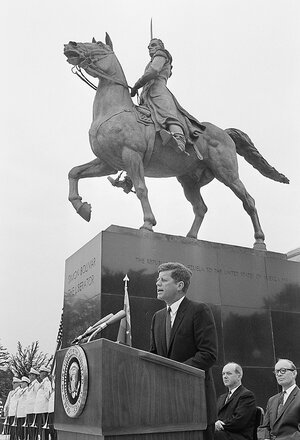
Yet America’s intervention follows a pattern in the U.S.-Venezuela story, one filled with inspiration and resistance. While Venezuela’s founders borrowed language from America’s 1776 Declaration of Independence when they demanded separation from Spain on July 5, 1811, its subsequent leadership warned against aligning too closely with the United States.
“Venezuelans had a great faith, enormous admiration, even a fascination with the United States, and a desire to emulate it,” says Tomás Helmut Straka Medina, a historian at Andrés Bello Catholic University in Caracas, the Venezuelan capital. “They decided to become a federal republic and the model they adopted was almost a carbon copy of the successful American one.”
But Venezuelan revolutionary hero Simón Bolívar, who would go on to proclaim the creation of a “Gran Colombia” – including present-day Colombia, Panama, Venezuela, and Ecuador – quickly saw the risks of aligning Venezuela too closely with the U.S.
In 1823, when President James Monroe warned European nations to abandon further colonial intervention in the Americas, Bolívar initially welcomed the gesture. But he later warned against what he saw as growing interventionism by the U.S.
Biographer Marie Arana wrote that Bolívar’s worldview was “a clear admonition to bullies.” Bolívar felt “South America needed no overseer, no higher might, no Monroe Doctrine. In his model, the will to power would come from the people themselves,” Ms. Arana writes in “Bolívar: American Liberator.”
For Latin Americans, American expansionism overshadowed the ideals of the American revolution. Long after Bolívar’s death in 1830, his rejection of U.S. hegemony in the region endured. His ideals inspired Mexican troops during the Mexican-American war of the 1840s, and again when America took control of Puerto Rico and Cuba near the end of the 19th century.
“There was a fear that the U.S. was simply going to swallow up all of Latin America and take control,” says Dr. Straka. “The figure of Bolívar was rescued as an ideological reference point against the United States…a rallying cry to stop the U.S. from transforming the region into one big American colony.”

Press Association/AP/File
Launching “trailblazers for freedom”
Máirtín Ó Muilleoir, a former Sinn Fein politician from Belfast and now publisher of the Andersontown News and the New York-based Irish Echo, says that the American Revolution provided a glimmer of hope for the Irish people through some 800 years of British rule.
“We are admirers of America not just for kicking out the rapacious British government from American shores,” says Mr. Ó Muilleoir, who served as a member of the Northern Ireland Assembly and as Lord Mayor of Belfast. “Those [American] idealists also shared ideals such as the rights of man, the rule of law. Without the American revolution there would not have been trailblazers for freedom, bringing together Catholics and Protestants fighting for a free Ireland.”
Sinn Fein – the political arm of the Irish Republican Army, which Britain labeled a terrorist group – can trace its roots to the underground movements of the 1790s, when disgruntled Catholic and Protestant Irishmen launched a brief rebellion that demanded equal rights and greater independence from Britain.
Inspired by the American revolution of 1775-1783 and the French revolution of 1789, the Society of United Irishmen followed the American example of calling for peaceful reform before resorting to violence.
Their rebellion was swiftly defeated – and Ireland was formally incorporated into the United Kingdom of Britain and Ireland in 1801 – but the rebellion of 1798 proved to be a point of no return. Irish separatist sentiment simmered, leading eventually to independence for the Republic of Ireland in 1921.
In the 1960s, a peaceful student movement revived those early calls for civil rights for all Irish people. Local police responded with a crackdown, pushing some activists to embrace more violent methods. From the late 1960s until well into the 1990s, paramilitary groups from both Catholic and Protestant populations waged war against each other and against British forces.
When peace was finally declared, it came in the form of a power-sharing agreement, brokered by the United States.
“I’m convinced that without America, we would be in a forever war,” Mr. Ó Muilleoir says. “That is America’s legacy.”

“A world of empires” falls
As a Haitian American, Magalie Laguerre-Wilkinson has always felt an ambivalence about the country that gave refuge to her father, a political exile, and her mother, a graduate student. Her parents saw themselves as “just passing through,” but were never able to return to Haiti, due to political instability.
Ms. Laguerre-Wilkinson says she admires America for its founding ideals, and for the incredible advances in science and technology, but adds that it is appropriate to point out when America fails to live up to its principles.
In this year’s 250th celebrations, Ms. Laguerre-Wilkinson will be thinking about the 500 black Haitian soldiers – all “gentlemen of color” – who played a crucial role in protecting the withdrawal of patriot and French troops at the Siege of Savannah in 1779.
Ms. Laguerre-Wilkinson says it is possible, indeed necessary, to confront America’s contradictions – of freedom and slavery – while recognizing its accomplishments.
“In the words of James Baldwin, ‘It’s because I love her that I can criticize her,’” says Ms. Laguerre-Wilkinson, an independent broadcast news journalist and host of an intergenerational podcast, “The What Just Happened? Podcast,” which discusses current events with adolescent co-hosts.
America’s revolutionary war was always messier than the simple tale taught in many high school history books, says Professor Bell. America’s Founding Fathers had competing and conflicting agendas when they drafted the Declaration of Independence. Mainly, he says, they were unified by their dissatisfaction with British rule.
Even so, they “bequeathed to us a weapon [the declaration] that has systematically been used to dismantle a world of empires and create a world of nation states. You can see that from Venezuela to Vietnam and everywhere in between. It’s a truly global legacy.”
Perhaps it helped that many of the Founding Fathers – think of it as a powdered-wig book club – were reading some of the same 17th and 18th century European philosophers of the Enlightenment, writers such as John Locke, Voltaire, and Montesquieu, who praised scientific advances, and preached that human beings had “natural rights” of life, liberty, and property, ideas that were already rippling through intellectual circles around the globe.
Ultimately, they reached a kind of consensus to break away from the British monarchy, and their greatest gift to future generations was a form of government that could be adapted to changing circumstances – as occurred when those “natural rights” were extended to formerly excluded people, such as women and once-enslaved Africans.
That evolutionary process continues, as it was designed to do by the Founding Fathers, Professor Bell says. “Thomas Paine said, in ‘Common Sense,’ ‘We have it in our power to begin the world over again.’”